

Dmitri Dragilew
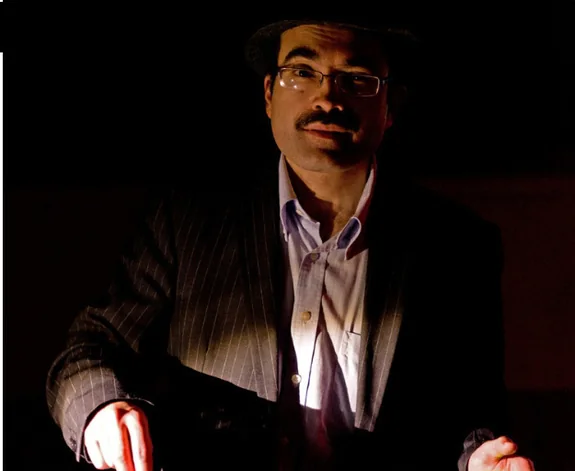
© Elena Dmitrieva
[...this is not a biography - in place of a footnote, and only as regards his journalistic experience: he served as editor-in-chief and head of the editorial office in Erfurt in the years 2000-2005. Later he became curator of the same editorial group and finally coordinator of the editorial group in Berlin (from 2011). Back in his home town of Riga he was a trainee and freelance contributor to the Russian desk of Latvian State Radio. From 1992 to 1995 he was responsible for a thematic feature, produced reportages and conducted interviews with well-known cultural figures. It was on Latvian Radio that he also first appeared as a singer-songwriter. One of his songs was used for ten years as the trailer opener of the programme «Tagaus tagein». In 2005 he interned at the broadcaster «Echo of Moscow»...]
For his volunteer work Dragilew received in 2007 the certificate of honour and the medal of honour of the Free State of Thuringia, presented by the Lord Mayor of the city of Erfurt and signed by the state's Minister-President.
- Literary-musical collage "Solyanka Autumn Style" after a humoresque by I. Schermann (2004)
- Two musicians and journalists in conversation: small talk with Oleg Molokoedow (2002)
- Radio Bridges Germany-Russia (in cooperation with Radio "Russkij Mir") 2011-13
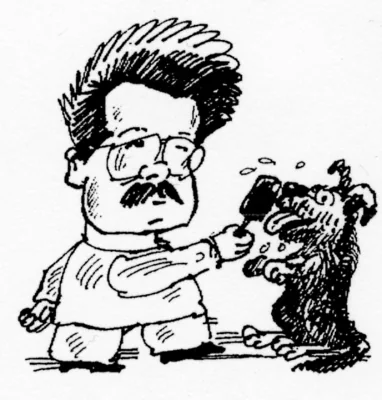
And how about an interview?
A report on the reading with Dmitri Dragilew organised by our colleagues from Berliner Literarische Aktion (Stadtsprachen/Parataxe):The Body of Language:
Stefanie Beckmann
As the reader of the German versions of his poems, Dmitri Dragilew had brought along the Slavist, translator and author Ruth Wynneken. For these two grandees of Berlin's Russian-speaking art scene, language is the alpha and the omega. Rendering Dragilew's complex poems is a true challenge, and so it came about that Ruth, originally meant only to recite his poems, became their translator while preparing for the reading.
The multilingual poems (besides Russian there are also Latvian, German, English and Yiddish set pieces) contain a rich and at times exotic lexicon. Verbal images often arrive in the form of a particular metaphor: the nested metaphor of the metarealists. Their greatest protagonist was the Russian Aleksej Parshchikov, to whose circle of friends the language artist Dmitri Dragilew once belonged. In the poems of this contemporary Berlin author, long-vanished realities of the Soviet era are interwoven with present-day experience and worked, sonically, into artworks of words.
Faced with this linguistic complexity, one senses the translator's horror - whose main task is to find linguistic equivalents and weave them into a tapestry of sound. As a musician, Dmitri keeps the sounding body of his verbal art in view, and the texts clearly betray his affinity for jazz.
His poems set off a movement in the minds of his listeners, supported by the calm poise of his delivery. A performative kind of reading takes place here in a most subtle way - but take place it does.
What makes the poems of Dmitri Dragilew?
The lyrical I perhaps does not stand at the centre of these poems at all; they are home to a densely populated, colourful cosmos of figures. The chosen figures - some from films, some from classical Russian literature, some from other sources known to this widely educated author - stand, with their intertextuality, for a level behind it all: the names form, as it were, the corridors between the realities.
It remains to be said that Dmitri Dragilew, too, is integrated with his poetry into the context of the Russian world. Russian literature, as Martin Jankowski points out, is alive and influential.
Further reading:
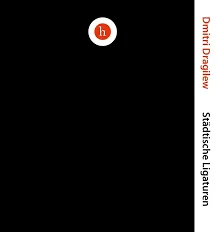
Städtische Ligaturen, Hochroth Verlag, 2016
More by and about Dmitri Dragilew at:
https://www.lyrikline.org/de/gedichte/
krasnorechivee-chem-abzac-zapadnee-na-obshirnom-12318
https://stadtsprachen.de/author/dmitri-dragilew/